The Most Violation-Dense Neighborhoods in Miami — And What That Actually Means for Buyers
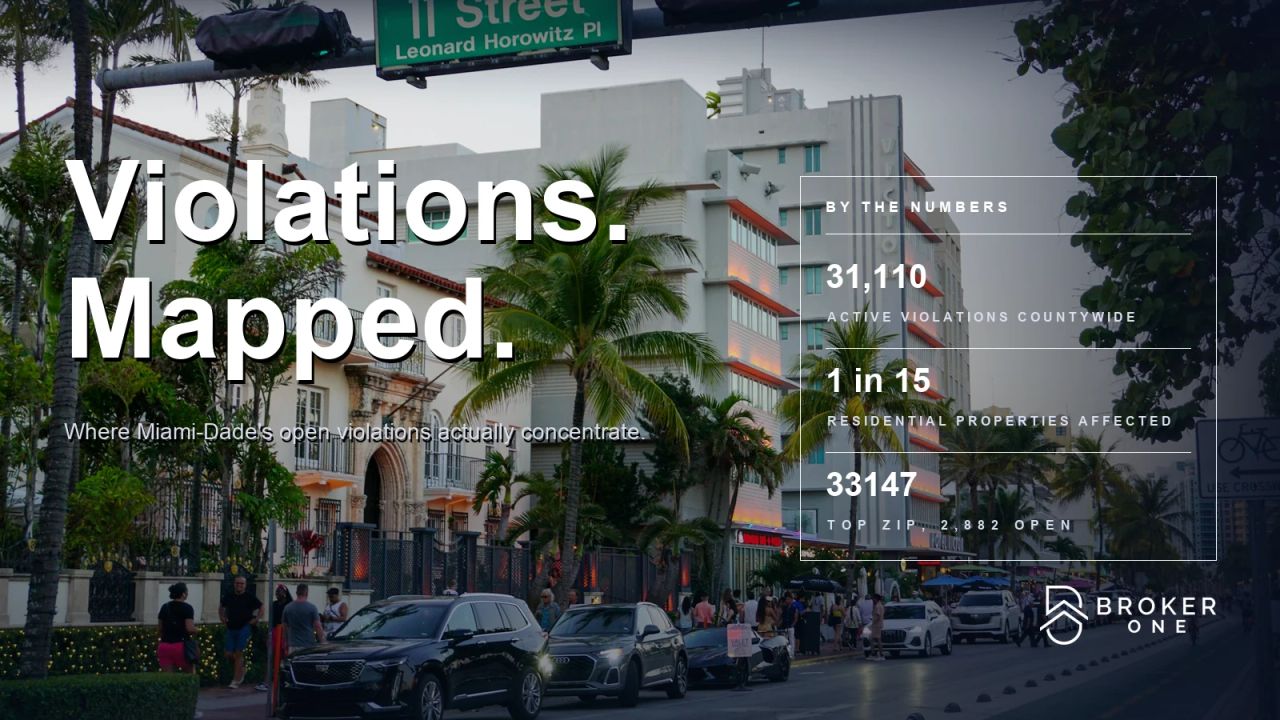
Let me be straight with you: if you're shopping for a home in Miami-Dade County right now, you're wading through a landscape of 31,110 active code violations spread across 19,071 properties. That's roughly one in every fifteen residential properties carrying some kind of open issue — expired permits, unsafe structure notices, zoning violations, you name it.
This is Part 2 of our 4-part series on unpermitted work and code violations in Miami-Dade. If you haven't read the overview yet, start with our pillar guide to unpermitted work in Miami-Dade. Coming up next: our buyer's guide to checking for unpermitted work before closing and a deep dive on investing in properties with code violations.
But here's the thing most people don't understand — violations don't distribute evenly. Some zip codes are practically clean, and others are drowning. Knowing where violations concentrate — and why — tells you a lot about a neighborhood's trajectory, the age of the housing stock, and whether that "great deal" is actually a money pit in disguise.
The Full Violation Map: Top 15 Zip Codes in Miami-Dade
We pulled violation data from Miami-Dade County records and ranked every zip code by total active violations. Here's what the top 15 look like:
| Rank |
Zip Code |
Neighborhood |
Expired Permits |
Unsafe Structures |
Total Violations |
Properties Affected |
| 1 | 33147 | Opa-locka / Miami Gardens | 535 | 311 | 2,882 | 1,767 |
| 2 | 33142 | Brownsville / Liberty City | 292 | 242 | 1,737 | 965 |
| 3 | 33155 | West Miami / Westchester | 307 | 120 | 1,246 | 782 |
| 4 | 33165 | Westchester / Tamiami | 205 | 63 | 981 | 668 |
| 5 | 33150 | North Miami / El Portal | 201 | 75 | 862 | 465 |
| 6 | 33179 | Ives Estates / Ojus | 258 | 68 | 689 | 383 |
| 7 | 33015 | Miami Lakes / Country Club | 197 | 72 | 627 | 391 |
| 8 | 33168 | North Miami Beach | 190 | 53 | 583 | 365 |
| 9 | 33175 | Fontainebleau / Sweetwater | 147 | 59 | 547 | 338 |
| 10 | 33162 | North Miami Beach | 147 | 42 | 451 | 284 |
| 11 | 33173 | Kendall / The Crossings | 130 | 53 | 421 | 254 |
| 12 | 33167 | North Miami / Norland | 105 | 27 | 421 | 272 |
| 13 | 33161 | North Miami / Biscayne Gardens | 100 | 80 | 417 | 265 |
| 14 | 33143 | South Miami / Coral Gables | 149 | 110 | 411 | 193 |
| 15 | 33172 | Doral / Sweetwater | 59 | 137 | 391 | 144 |
Countywide totals: 31,110 violations across 19,071 properties, including 7,883 expired permits and 3,170 unsafe structure notices. Explore the full interactive map on Broker One.
The Top 5: Neighborhood-by-Neighborhood Breakdown
1. ZIP 33147 — Opa-locka / Miami Gardens (2,882 Violations)
This isn't going to surprise anyone who's driven through Opa-locka. The area sits at the top of the violation chart by a massive margin — nearly double the next zip code. With 1,767 properties carrying violations, that's a staggering density.
Here's what's happening: 33147 has some of the oldest housing stock in northern Miami-Dade, much of it built in the 1950s and '60s. A lot of these homes are owned by families who've been there for generations but don't have the cash to pull permits for roof repairs or electrical upgrades. You also have a wave of out-of-state investors who bought cheap during the 2010s foreclosure era and did the bare minimum — or less. The 311 unsafe structure notices tell that story clearly.
If you're looking at a property here, get a thorough inspection and pull the permit history on Broker One's neighborhood page for 33147 before you even think about making an offer. The upside? Prices remain among the most accessible in the county, and the area is slowly getting county attention for reinvestment. Just know what you're walking into.
2. ZIP 33142 — Brownsville / Liberty City (1,737 Violations)
Liberty City and Brownsville carry a complicated legacy. These are historically Black neighborhoods that endured decades of disinvestment, and the housing stock shows it. With 242 unsafe structure notices — the second highest in the county — you're looking at properties where deferred maintenance has crossed into structural territory.
But there's a flip side. Liberty City is one of Miami's most actively redeveloping areas. New affordable housing projects, transit improvements, and commercial investment are flowing in. The tension? New builds going up next to homes with 30-year-old roofing and knob-and-tube wiring that nobody ever permitted a replacement for. If you're an investor eyeing this zip, our guide to investing in properties with code violations is essential reading.
Check every property through the violation lookup for 33142 — seriously, every single one.
3. ZIP 33155 — West Miami / Westchester (1,246 Violations)
Now here's where it gets interesting. 33155 is not a low-income neighborhood. Westchester is solidly middle-class, predominantly Cuban-American, and one of the most popular family neighborhoods in Miami. So why 1,246 violations?
Two words: DIY culture. Westchester is full of homeowners who converted garages into in-law suites, added Florida rooms, built out patios, and enclosed carports — all without pulling a single permit. It's been the norm for decades. The 307 expired permits are mostly projects where someone started the permit process, got the work done, and never bothered with final inspection.
This creates a specific headache for buyers: the home looks great, it's been "renovated," but none of it is on the books. Your insurance company will care. Your lender's appraiser will care. And if you ever need to sell, the next buyer's agent will absolutely care. View the full profile for 33155.
4. ZIP 33165 — Westchester / Tamiami (981 Violations)
Directly south of 33155, this zip covers the Tamiami corridor and deeper Westchester. Same story, slightly less concentrated: aging ranch-style homes from the '70s, a culture of owner-performed renovations, and a lot of expired permits from contractors who closed work orders but skipped finals.
The 63 unsafe structures are relatively low for the violation count, which is actually a good sign — it means most violations here are administrative (expired permits, zoning setback issues) rather than genuinely dangerous conditions. Still, 668 properties flagged means roughly 1 in 8 homes has something open. That's high enough to warrant a pre-purchase permit check on anything you're considering.
5. ZIP 33150 — North Miami / El Portal (862 Violations)
El Portal and the surrounding North Miami pockets are gentrifying fast. That's actually part of the problem. You have two violation drivers happening simultaneously: older properties with decades of deferred maintenance and new flippers doing aggressive renovations on tight timelines, cutting corners on permits to save weeks.
The 75 unsafe structure notices point to the older housing stock — small concrete block homes from the '50s that were never updated to modern wind mitigation standards. But the 201 expired permits? That's flip-and-go culture. Someone buys a property, guts it, pulls permits for some of the work, skips permits on the rest, and lists it as "fully renovated." Dig into 33150's full data before you fall for the staging.
Why Do Violations Concentrate? The Three Patterns
Pattern 1: Aging Housing Stock + Low Income = Deferred Maintenance
This drives the numbers in 33147, 33142, 33167, and 33168. Homes built in the mid-20th century that need serious capital improvements — roof replacements, electrical panel upgrades, plumbing overhauls — owned by people who simply can't afford $15,000-$40,000 in permitted work. So repairs happen piecemeal, unpermitted, often by handymen rather than licensed contractors. The violations pile up.
Pattern 2: DIY Homeowner Culture = Unpermitted Additions
This is the Westchester effect (33155, 33165, 33175). Middle-class homeowners who view permits as unnecessary bureaucracy. They'll spend $30,000 on a kitchen remodel and never pull a single permit because "my guy does good work." These areas have high expired permit counts because when someone does start the process, they rarely finish it.
Pattern 3: Investor Flips = Corner-Cutting
Visible in 33150, 33143, and 33161 — areas where flipping activity is high. The economics are simple: every week a property sits waiting for permit approval is a week of carrying costs. So flippers pull permits for the big-ticket items (roof, HVAC) and skip the rest (bathroom reconfigurations, added square footage, window replacements). The result? A house that looks move-in ready but has open violations buried in the county system.
The Surprise on the List: 33143 South Miami / Coral Gables
When people see Coral Gables on a violation list, they do a double-take. This is one of Miami's wealthiest municipalities. But look at the numbers: 149 expired permits and 110 unsafe structures across only 193 properties. That means most flagged properties have multiple violations each.
What's happening here is different from Opa-locka or Liberty City. Coral Gables has some of the strictest building codes in the county — historic preservation overlays, architectural review boards, setback requirements that are tighter than county standard. Wealthy homeowners undertake major renovations, run into permitting complications, and abandon the process midway. The "unsafe structure" designation in 33143 often relates to older historic homes where the city has flagged structural concerns during routine review, not necessarily condemned buildings.
Still — if you're paying $800,000+ for a home, you want to make sure that gorgeous pool deck and guest house are actually on the permit. Check the violation data for 33143.
What This Means If You're Buying in Miami Right Now
Here's my honest take, the kind of advice a friend who's been in this market for years would give you:
- Always run a violation check before making an offer. It takes five minutes on Broker One. The information is free. There is no excuse for being surprised at closing.
- Violations aren't always deal-breakers. An expired permit for a roof replacement that was actually completed and passed rough inspection? That's fixable for a few hundred bucks. An unsafe structure notice on a load-bearing wall someone removed? That's a different conversation entirely.
- High-violation zip codes can be opportunities — if you know what you're doing. Buying a property with curable violations at a discount is a legitimate strategy. Read our investment guide for violation properties before you try it.
- The zip code doesn't tell the whole story. Even in 33147, plenty of properties are clean. And in "nice" zip codes like 33143, individual properties can be a mess. Always check the specific parcel.
Frequently Asked Questions
What are the areas to avoid in Miami?
It depends entirely on what you mean by "avoid." If you're asking about code violations and building safety, zip codes 33147 (Opa-locka), 33142 (Liberty City), and 33155 (Westchester) carry the highest violation counts in the county. But "avoid" is too simple — 33155 is one of Miami's best family neighborhoods despite the violation numbers. The smarter question is: what's the condition of the specific property you're looking at? Use Broker One's property search to check any address for violations, permits, and ownership history before you decide.
Which neighborhoods are safe in Miami?
From a building-code perspective, newer construction areas in west Kendall, Doral's newer subdivisions, and recently developed pockets of Aventura tend to have far fewer violations simply because the housing stock is younger. But even in those areas, individual properties can have issues — especially condos where building-wide violations may not show up on a unit-level search. Safety is property-specific, not zip-code-specific. Check every address individually through our violation database.
Can I see code violations on a map for Miami?
Yes. Broker One's unpermitted work analysis tool maps every active code violation and expired permit in Miami-Dade County. You can search by address, zoom into any neighborhood, and see violation density by zip code. All data is sourced directly from county records and updated weekly.
Do code violations affect property values?
Absolutely. Properties with open code violations typically sell for 5-15% less than comparable clean properties, depending on the severity. Unsafe structure notices have the biggest impact — they can make a property unlendable, meaning you're limited to cash buyers. Expired permits for completed work are less damaging but still create friction at closing. Our full analysis of unpermitted work in Miami-Dade breaks down the financial impact in detail.
Series Navigation
This is Part 2 of 4 in our Miami-Dade Code Violations series:
- Unpermitted Work in Miami-Dade: The Complete 2026 Analysis (Pillar)
- The Most Violation-Dense Neighborhoods in Miami (You are here)
- How to Check for Unpermitted Work Before Buying in Florida
- Investing in Properties with Code Violations in Florida