The deferral that pays for the next building
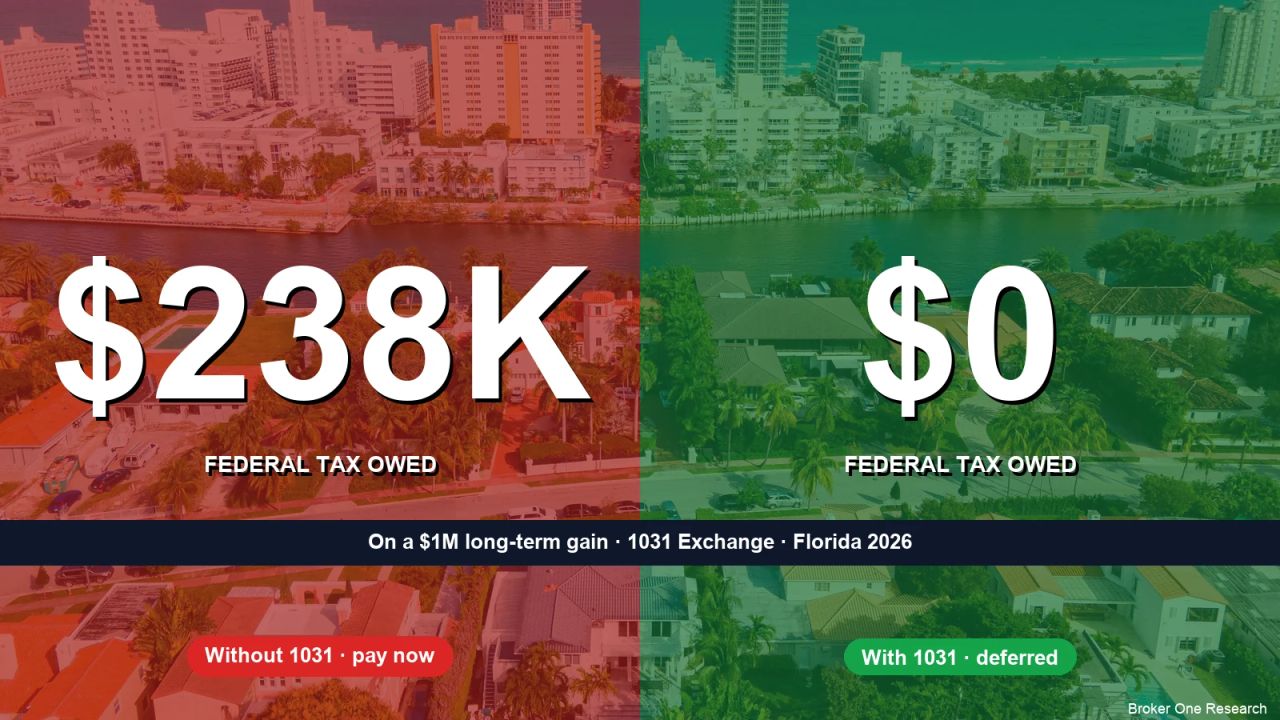
If you sell a Florida investment property at a gain and don't reinvest through a 1031 exchange, the federal government takes 15-23.8% of that gain in capital gains tax plus net investment income tax. On a $1M property bought for $400K and sold for $900K, that's a $500K gain and roughly $100K-$120K in federal tax owed in the year of sale. Money that could have been the down payment on the next building, gone to the IRS instead.
The 1031 exchange under IRC Section 1031 lets a Florida investor defer that tax indefinitely by rolling the proceeds into another investment property. Florida has no state income tax, so unlike investors in California, New York, or Massachusetts, Florida 1031 users save only the federal layer. That is still material money on a six- or seven-figure gain. The mechanics, the 45-day clock, and the Qualified Intermediary requirement make 1031 unforgiving of mistakes, but the framework is straightforward once mapped.
| The 1031 cheat sheet | |
|---|
| Day 0 | Close the relinquished property; the Qualified Intermediary receives the proceeds |
| Day 45 | Identify replacement property in writing — hard deadline, no extensions |
| Day 180 | Close on replacement property, also hard, even if it lands on a weekend |
| State tax | Florida: $0. Federal capital gains plus 3.8% NIIT only |
| QI cost | $750-$2,500 per exchange, depending on complexity |
| Hold period | No statutory minimum, but IRS scrutiny rises if the replacement is held under 24 months |
What qualifies and what doesn't
The 2017 Tax Cuts and Jobs Act narrowed Section 1031 to apply only to real estate. Stocks, equipment, vehicles, and partnership interests no longer qualify. What does qualify for a Florida investor:
- Investment or business-use property. A Brickell rental condo, a Sunny Isles rental unit, an Edgewater duplex, a Wynwood retail strip, an Aventura office. The property must be held for investment or business use, not personal use.
- Like-kind doesn't mean identical. A single-family rental can be exchanged for a multifamily building, a vacant lot, an industrial warehouse, or any other US real estate. The bar is "real property held for investment," not matching property type.
- US property only. Florida real estate exchanged for foreign property does not qualify. A 1031 from Miami to a Bahamas condo fails.
- Same taxpayer. If the relinquished property is held in an LLC, the replacement must close in the same LLC (or a disregarded entity treated as the same taxpayer for federal purposes).
What disqualifies: a primary residence, a second home used personally, fix-and-flip inventory (held for resale rather than investment), and partnership interests where the partnership itself owns the real estate.
The 45-day clock is the rule that breaks deals
From the day the sale of the relinquished property closes, a Florida investor has 45 calendar days to identify potential replacements in writing, signed and delivered to the Qualified Intermediary or another party to the exchange. Verbal identification doesn't count. The IRS does not extend this deadline for hurricanes, holidays, or seller delays.
Three identification methods are allowed. Pick one and stick with it on the identification document; mixing methods voids the exchange.
- Three-property rule
- Identify up to three replacement properties of any value. The simplest path; works for most investors. Buy any one, two, or all three within 180 days.
- 200% rule
- Identify any number of properties whose combined fair-market value does not exceed 200% of the relinquished property. Used when the investor wants flexibility across many candidate properties.
- 95% rule
- Identify any number of properties of any value, but the investor must actually acquire 95% of the total identified value within 180 days. Highest-risk method; used rarely.
The 180-day close is the second tripwire
From the relinquished sale date, the investor has 180 calendar days (or the federal tax filing deadline including extensions, whichever is earlier) to close on the replacement property. The 45-day identification clock and the 180-day close clock run concurrently; they do not stack. A property identified on Day 44 still must close by Day 180.
The "or tax filing deadline" wedge bites investors who close late in the year. A relinquished sale closing November 15 has a 180-day clock running to May 14, but if the investor's federal return is due April 15 with no extension filed, the 180-day window collapses to April 15. Filing for the automatic extension preserves the full 180 days.
Florida-specific mechanics
The headline Florida advantage is structural. No state income tax means a 1031 in Miami defers only federal capital gains tax, where the same exchange in California also defers up to 13.3% state tax and in New York 10.9% state plus city tax. The trade-off is that the federal-only saving is the only saving; Florida investors deciding whether to pay tax now versus chain into another property need to model just the federal layer (typically 15-23.8% combined LTCG plus NIIT), not the state layer too.
Three Florida wrinkles worth knowing:
- Documentary stamp tax still applies. Florida charges $0.70 per $100 of consideration on deed transfers ($0.60 in Miami-Dade for residential), and 1031 status does not waive it. On a $2M replacement closing, that's roughly $14,000 of doc stamps the buyer covers regardless of 1031 treatment. Budget it into the replacement-side cash needs.
- SB 4-D timing pressure on condos. Investors holding pre-1992 Florida condos facing milestone inspections and structural reserve assessments may have a narrower window between "hold for the deferral" and "sell before the assessment hits and the building's market value drops." See our SB 4-D buyers' guide for inspection deadlines by year-built tier.
- LLC-of-record matching. Florida investor inventory skews heavily toward LLC ownership, particularly in the marquee zips of Brickell, Sunny Isles, and Edgewater. Title companies and QIs need the relinquished and replacement deeds to vest in matching taxpayer entities, otherwise the exchange fails the "same taxpayer" test. Forming a new LLC right before closing the replacement is a common error that can void the deferral.
The Qualified Intermediary: who they are and what they cost
A Qualified Intermediary (QI), also called an Accommodator, is the third party that holds the relinquished sale proceeds and assigns the contracts that make the exchange work. The IRS effectively requires a QI for any delayed (forward) exchange. The investor cannot touch the proceeds between the sale and the replacement close, or "constructive receipt" voids the exchange.
What a QI does:
- Drafts the exchange agreement and assignment documents
- Holds the relinquished sale proceeds in a segregated account during the exchange period
- Receives the 45-day identification document from the investor
- Wires funds to the closing of the replacement property
- Provides Form 1099-S and tax-reporting support for the exchange
Cost in Florida: roughly $750-$1,500 for a straightforward delayed exchange, $2,000-$5,000 for reverse (acquiring the replacement before selling the relinquished) or build-to-suit exchanges. The QI fee is small money next to the federal tax deferral on a six-figure gain.
What to verify before signing with a QI:
- Errors-and-omissions insurance and fidelity bond. The QI is holding your money. Verify coverage limits at least equal to your sale proceeds.
- Segregated escrow accounts. Funds should sit in a separate account in your name, not commingled with other clients' or the QI's operating funds. Ask for the bank, account structure, and FDIC coverage details in writing.
- Operating history and references. 1031 QIs are not federally licensed. Florida has no state-level QI licensing either. Length of operating history, references from past clients, and audited financials are the main signals.
- Independence. The QI cannot be the investor's attorney, CPA, real estate agent, or anyone who has acted as the investor's agent within the prior two years. The IRS calls this the "disqualified person" rule. A national QI or independent local firm avoids the trap.
When a 1031 is the wrong move
1031 is a deferral, not a free pass. Tax basis transfers into the replacement property, so the deferred gain comes due if the investor ever sells without exchanging again. The correct mental model is "defer until step-up": hold the chain until heirs inherit at fair-market basis (current law) and the deferred gain is wiped at the owner's death.
Cases where paying the tax now beats deferring:
- The replacement property the investor would buy under 1031 pressure isn't the property they would buy without it. Buying mediocre real estate to dodge tax is worse than paying tax on the sale and waiting for a better deal.
- The capital gain is small and the deal is simple. On a $50K gain, the QI fee plus due-diligence cost can erode the benefit.
- The investor needs cash immediately. 1031 locks proceeds into real estate; if liquidity is the goal, take the gain and pay the tax.
- Loss harvesting. If the investor has offsetting capital losses from other holdings, paying the gain to use the loss may be more efficient than deferring.
- The family plan no longer involves real estate. If the eventual exit is liquidation rather than step-up at death, the deferral compounds the eventual tax bill rather than eliminating it.
Frequently asked questions
What is the 2-year rule for a 1031 exchange?
The 2-year rule under Section 1031(f) governs related-party exchanges. If a Florida investor exchanges with a related party (sibling, parent, child, grantor trust, or controlled entity), both the investor and the related party must hold their respective properties for at least two years after the exchange. If either side disposes within two years, the original exchange is retroactively disallowed and the deferred gain becomes taxable in the year of the original exchange. The IRS treats this rule strictly; the only narrow exceptions are death, involuntary conversion, or transactions where avoidance of federal income tax is not a principal purpose.
Can I do a 1031 exchange on a Florida vacation home?
Only if the property qualifies as held for investment, not personal use. IRS Revenue Procedure 2008-16 sets a safe harbor: the property must have been rented at fair-market value for at least 14 days in each of the two years preceding the exchange, and personal use cannot exceed 14 days or 10% of the rented days, whichever is greater. A Sunny Isles or South Beach condo used primarily as a personal getaway with sporadic rental income generally fails this test. Convert it to a true rental at least two years before the planned exchange to satisfy the safe harbor.
How long must I hold a Florida rental before doing a 1031?
There is no statutory minimum, but the property must demonstrably have been held for investment or productive business use rather than for resale. The IRS has not codified a hold period for the relinquished property, but practitioners generally regard 12-24 months as the prudent floor. Holding for less than a year invites scrutiny; holding for less than six months commonly draws an audit. The replacement-side hold period matters too; the IRS may attack a sequence of rapid in-and-out exchanges as inconsistent with investment intent.
Do fix-and-flip properties qualify for a 1031?
No. Property held primarily for resale is dealer inventory, not investment property. A fix-and-flip operator selling a renovated house cannot defer the gain through a 1031 because the property fails the "held for investment" test from day one. Investors who are unsure should look at how prior tax returns characterized the property: ordinary-income reporting points to dealer status, capital-gain reporting points to investment status. The classification is intent-based and fact-specific; consult a tax advisor before assuming a recently held flip is exchangeable.
Can I exchange a Florida property for one in another state?
Yes. Like-kind under Section 1031 covers any US real estate held for investment, regardless of state. A Brickell condo can be exchanged for a Texas commercial building, a Tennessee farmland tract, or a New York office floor. The state-tax math reverses, though: a Florida investor moving into California real estate inherits California source-state tax rules on rental income going forward, and a future sale of the California replacement may trigger California state tax even if the original Florida sale was state-tax-free. Plan for the destination-state tax exposure, not just the federal deferral.
What happens if I miss the 45-day deadline?
The exchange fails. The relinquished sale becomes a fully taxable transaction in the year it closed, and the deferred gain becomes immediately due. The IRS does not extend the 45-day window for storms, holidays, contract delays, or the investor changing their mind about the replacement. The single relief mechanism is a federal disaster declaration that explicitly extends 1031 deadlines, which has been used after major hurricanes affecting Florida; the Qualified Intermediary will typically alert clients if a declaration applies. Otherwise, plan to identify by Day 30 to leave room for surprises.
How does a reverse exchange work in Florida?
A reverse exchange flips the order: the replacement property is acquired before the relinquished property is sold. The Qualified Intermediary (or a related Exchange Accommodation Titleholder) parks title to the replacement until the relinquished sale closes. Florida investors use reverse structures when the replacement is a hot-listing condo or trophy unit that won't wait for the relinquished sale. Costs are higher ($3,000-$8,000 typical QI fee) and the 180-day clock still applies, measured from the date the EAT acquires title. Reverse 1031s require strong cash or financing for the replacement, since the relinquished proceeds aren't yet available.
Read next: Miami New Construction Condos 2026: Pipeline & Absorption · Edgewater sells, Worldcenter doesn't: per-tower absorption · Florida SB 4-D Buyers' Guide · Florida Home Insurance by County 2026 · Mortgage affordability calculator