Best Condo Buildings in Brickell Miami — 2026 Buyer's Guide
Brickell is Miami's financial district, and over the past decade it has transformed from a cluster of office towers into one of the most dynamic urban neighborhoods in the country. Today it's a vertical city: glass towers stacked with residences, restaurants at street level, the Metromover overhead, and Brickell City Centre anchoring the retail core. If you want to live in Miami without needing a car, Brickell is your best bet.
It's also the most active condo construction market in South Florida right now. The pipeline for 2025-2028 includes some of the most ambitious branded-residence projects ever attempted in the U.S. — Baccarat, St. Regis, Cipriani, Mercedes-Benz, Waldorf Astoria, and Dolce & Gabbana are all building here. That's exciting, but it also means supply is coming, and not all of these buildings will perform equally as investments.
This guide separates the signal from the noise. Here are the condo buildings in Brickell worth your attention in 2026 — and the honest trade-offs for each.
This is part of our Best Condos in Miami series. Also see: Miami Beach | Sunny Isles Beach | South Beach | South of Fifth
Brickell's Condo Market in 2026: What You Need to Know
Before looking at individual buildings, here's the macro picture:
- Massive new supply is coming. Over 5,000 new condo units are in the pipeline for Brickell and the adjacent Brickell Key area through 2028. This is the largest wave of condo construction since the pre-2008 boom. Supply pressure is real — don't assume every new tower will appreciate from day one.
- The branded-residence boom. Brickell is ground zero for luxury brand-name condo projects. These buildings command 20-40% premiums over comparable unbranded towers. Whether that premium holds long-term depends on the brand's operational involvement and the building's actual quality, not just the name on the lobby.
- Transit is a genuine advantage. Brickell is the only Miami neighborhood with real public transit. The Metromover (free) connects to downtown, Brickell City Centre, and the Metrorail. If you work in downtown Miami, Coral Gables, or the Health District, you can commute without a car. That's a rare thing in this city.
- Foreign buyer demand remains strong. Latin American buyers — particularly from Argentina, Colombia, Venezuela, and Brazil — continue to view Brickell as a safe haven for capital. This demand floor supports pricing even when domestic demand softens.
- Rental market is deep. Unlike South Beach or SoFi, most Brickell buildings allow annual rentals, and demand from young professionals and relocating workers keeps vacancy rates low. Cap rates aren't spectacular (3-5%), but rental income is reliable.
Top Condo Buildings in Brickell — 2026 Rankings
1. Baccarat Residences Miami
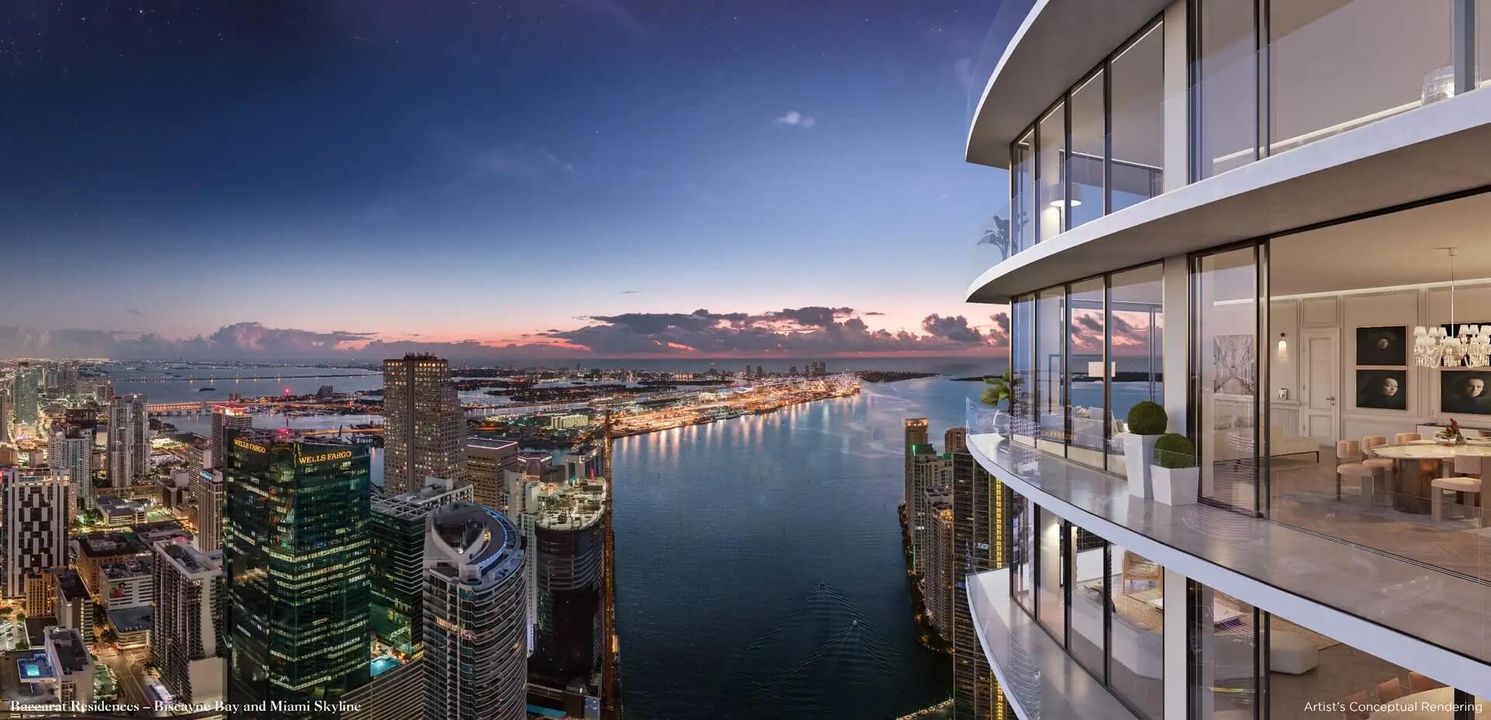
444 Brickell Avenue. The most anticipated luxury condo delivery in Brickell, Baccarat brings the French crystal brand's aesthetic to a 75-story tower. Interiors by Meyer Davis Studio, with Baccarat chandeliers in the common areas (naturally). The building will include a private residents' club, pool deck, spa, and Baccarat-branded dining. Units start around $1.5M and climb well past $10M for upper-floor residences. Pre-construction pricing has been aggressive — $1,500-$2,500/psf — but the building's location directly on Brickell Avenue and the brand's cachet are drawing serious buyers. The risk: branded residences depend on the management company maintaining brand standards post-delivery. If service quality slips, the premium evaporates.
2. St. Regis Residences Brickell
1809 Brickell Avenue. Two towers (44 and 48 stories) from the Related Group, carrying the St. Regis hospitality brand. Expect butler service, a signature St. Regis bar, and the white-glove experience that defines the brand globally. Units range from $1.2M to $8M+. The Brickell Avenue location provides direct Metromover access and walkability to Brickell City Centre. St. Regis has a longer track record in branded residences than most competitors, which reduces operational risk. The trade-off: the two-tower format means more units (over 300 total), which could create resale competition among sellers within the building itself.
3. Cipriani Residences Miami
1420 South Miami Avenue. The Italian hospitality brand brings its signature restaurant (Cipriani Downtown) and members' club to a 80-story tower — set to be one of the tallest residential buildings in the southeastern U.S. Units feature interiors by 1508 London, the design firm behind many of Cipriani's global properties. Pricing starts around $1M for smaller units. The restaurant and club are the real draw — residents get priority access and a built-in social scene. The building's height means spectacular views from upper floors but also longer elevator wait times and more units competing for the same amenities.
4. The Residences at 1428 Brickell
1428 Brickell Avenue. Developed by Ytech, this 70-story tower focuses on ultra-luxury without a hotel brand. That's a deliberate choice — no hotel guests sharing your amenities, no brand-mandated service charges. Interiors by Italian design house Giorgetti. Pricing starts around $2M. The building promises a more residential, less hospitality-driven experience. For buyers who want luxury without the hotel-condo premium, 1428 Brickell is a strong contender. The risk: without a brand name, the building needs to establish its own identity in a market crowded with recognizable logos.
5. Mercedes-Benz Places
A bold bet at 851 NE 1st Avenue (technically Brickell-adjacent in the Arts District), this is the first residential project by Mercedes-Benz. Two towers with 791 units, interiors inspired by automotive design — think leather, aluminum, and clean engineering-driven aesthetics. Pricing starts around $600K, making it one of the more accessible new-construction options. Mercedes-Benz's brand resonates strongly with Latin American buyers, and the lower price point should drive strong sales velocity. The concern: 791 units is a lot of supply in a single project, and the Arts District location is still evolving. You're buying into the neighborhood's future, not its present.
6. 888 Brickell by Dolce & Gabbana
888 Brickell Avenue. The first real estate project by D&G, developed in partnership with JDS Development. A 90-story tower designed by Sieger Suarez with interiors reflecting D&G's maximalist Italian aesthetic — expect bold patterns, statement lighting, and unapologetic glamour. Pricing starts around $1.5M. The brand's polarizing aesthetic is either a major draw or a dealbreaker — there's no middle ground. If the D&G aesthetic aligns with your taste, this building will feel like nowhere else in Miami. If it doesn't, no amount of appreciation potential will make you comfortable in the lobby.
7. Waldorf Astoria Residences
300 Biscayne Boulevard (Downtown/Brickell border). Designed by Carlos Ott and Sieger Suarez, this 100-story tower will be the tallest building in Florida and one of the tallest south of New York. The Waldorf Astoria brand carries significant weight, and the building will include hotel rooms, residences, and amenities spread across its supertall height. Units start around $1M. The views from upper floors will be genuinely unmatched — on a clear day, you'll see from Key Biscayne to Fort Lauderdale. The risk: supertall buildings have higher operating costs (elevator maintenance, wind load engineering, insurance), which eventually flow through to HOA fees.
8. Lofty Brickell
2600 South Miami Avenue. Positioned at the southern edge of Brickell near the Rickenbacker Causeway, Lofty offers a slightly different proposition: fewer floors (35 stories), more residential feel, and proximity to Key Biscayne. Units start around $500K for studios. The rooftop pool with bay views and the building's more intimate scale appeal to buyers who find the mega-towers overwhelming. Location-wise, you're at the quieter end of Brickell, which means less walkability to Brickell City Centre but easier access to Coconut Grove and Key Biscayne.
9. 1010 Brickell
1010 Brickell Avenue. An established tower (completed 2018) that has proven itself in the market. 387 units with excellent amenities: rooftop pool, indoor basketball court, spa, and a location directly on Brickell Avenue. Units range from $500K to $3M. The building's track record gives you something pre-construction projects can't: actual performance data. You can see real HOA fees, real reserve funding, real rental history. For risk-averse buyers, an established building like 1010 Brickell eliminates the guesswork of pre-construction.
10. Bristol Tower
2127 Brickell Avenue. A Ugo Colombo-developed tower from 2000 that remains one of Brickell's most respected addresses. Only 146 units, each with private elevator entry and generous layouts. Bayfront location with direct views of Biscayne Bay and Key Biscayne. Units range from $800K to $4M. Bristol Tower offers an established luxury experience without the hotel-condo overhead. The building is well-managed with healthy reserves. At 26 years old, some units need renovation, but the bones are excellent. This is the anti-hype play — no brand name, no Instagram presence, just solid real estate.
11. Plaza on Brickell
950 Brickell Bay Drive. Two towers (East and West) completed in 2007 with over 900 combined units. Direct bayfront location with water views from east-facing units. Pricing ranges from $350K to $2M, making this one of Brickell's most accessible options. The buildings have solid amenities and the bayfront location is genuinely premium. The trade-off: the unit count is massive, which means the building sometimes feels more like a city block than a community. But for the price-per-square-foot with water views, Plaza on Brickell is hard to beat.
12. Neo Vertika
690 SW 1st Court. A loft-style building in the west Brickell/River area with 28-story towers and a hip, urban vibe. Units feature high ceilings, exposed concrete, and a more downtown-loft aesthetic than the typical glass tower. Pricing starts around $300K — among the lowest in greater Brickell. The rooftop pool and gym are solid, and the Arts & Entertainment district is evolving rapidly around it. Best for younger buyers, investors, and anyone who prefers industrial-chic over marble-and-crystal luxury.
13. Rivage
1 Brickell Key Drive (Brickell Key). The latest tower planned for Brickell Key — the private island connected to Brickell by a single bridge. Rivage will be a 65-story, 255-unit tower developed by the Related Group. The Brickell Key location offers something unique: island living within the urban grid. No through-traffic, a running loop around the island, and direct bay views in every direction. Pre-construction pricing starts around $2M. The island format is a genuine lifestyle differentiator, but it also means one access point — during events or emergencies, the single bridge can be a bottleneck.
14. Villa Miami
788 Brickell Plaza. Developed by Major Food Group (the team behind Carbone and Dirty French) in partnership with the Related Group. The restaurant connection is the headline: residents get priority at Major Food Group venues and a private residents' restaurant in the building. A 57-story tower with 648 units. Pricing starts around $800K. This is a lifestyle play — if you eat out regularly and value the Miami food scene, having Major Food Group as your building operator is a genuine amenity. The risk: the restaurant partnership needs to endure. If Major Food Group exits or the venues underperform, the building's key differentiator disappears.
Brickell Condo Comparison Table
| Building |
Year |
Units |
Price Range |
Price/SqFt |
Branded |
Best For |
| Baccarat Residences |
2026 |
360 |
$1.5M–$10M+ |
$1,500–$2,500 |
Yes |
Ultra-luxury buyers |
| St. Regis Residences |
2027 |
300+ |
$1.2M–$8M+ |
$1,400–$2,200 |
Yes |
Hospitality-minded buyers |
| Cipriani Residences |
2028 |
397 |
$1M–$7M+ |
$1,200–$2,000 |
Yes |
Social scene, dining |
| 1428 Brickell |
2027 |
189 |
$2M–$10M+ |
$1,800–$2,800 |
No |
Pure residential luxury |
| Mercedes-Benz Places |
2027 |
791 |
$600K–$3M |
$800–$1,400 |
Yes |
Accessible branded |
| 888 Brickell D&G |
2028 |
259 |
$1.5M–$10M+ |
$1,500–$2,500 |
Yes |
Design-statement buyers |
| Waldorf Astoria |
2027 |
360 |
$1M–$8M+ |
$1,200–$2,000 |
Yes |
Iconic supertall views |
| Lofty Brickell |
2026 |
364 |
$500K–$2M |
$700–$1,100 |
No |
Quiet end of Brickell |
| 1010 Brickell |
2018 |
387 |
$500K–$3M |
$600–$1,000 |
No |
Proven track record |
| Bristol Tower |
2000 |
146 |
$800K–$4M |
$550–$900 |
No |
Established bayfront luxury |
| Plaza on Brickell |
2007 |
900+ |
$350K–$2M |
$400–$700 |
No |
Value bayfront entry |
| Neo Vertika |
2006 |
401 |
$300K–$800K |
$350–$550 |
No |
Budget, loft-style |
| Rivage |
2028 |
255 |
$2M–$8M+ |
$1,600–$2,500 |
No |
Island living, privacy |
| Villa Miami |
2027 |
648 |
$800K–$4M |
$900–$1,500 |
Yes (MFG) |
Food scene, lifestyle |
Brickell Buyer Strategy for 2026
The Pre-Construction Gamble
Most of the top-tier buildings on this list are pre-construction or recently delivered. That means you're buying based on renderings, developer promises, and projected delivery dates. The standard deposit structure is 50% during construction (in installments tied to milestones) with the balance at closing. If the market softens before delivery, you're still obligated to close at the contracted price. The upside: pre-construction pricing is typically 10-20% below what the developer expects to achieve on resale. If the market holds or appreciates, you capture that gain. The downside: delays happen, specifications change, and you're tying up significant capital in deposits for 2-3 years with no rental income.
Established Buildings: The Underrated Play
While the market focuses on new construction, established towers like 1010 Brickell, Bristol Tower, and even Plaza on Brickell offer something valuable: certainty. You can see the actual building, walk through the actual unit, review actual HOA financials, and talk to actual residents. The price per square foot is dramatically lower — $400-$1,000/psf versus $1,200-$2,500/psf for new construction. Yes, you may need to renovate a kitchen or update bathrooms. But a $100K renovation on a unit purchased at $600/psf still comes out well ahead of buying new construction at $1,800/psf.
The Branded Premium: Worth It?
Brickell's branded-residence wave is unprecedented. But here's the uncomfortable question: does a Baccarat chandelier in the lobby translate to 30% higher appreciation? The data is mixed. Branded residences generally hold value better during downturns because the brand's global marketing supports demand. But they also carry higher HOA fees to fund brand-standard services. The best-performing branded residences are those where the brand actually operates the building (St. Regis, Waldorf Astoria), not just licenses its name. Ask what happens to the brand relationship after delivery — a 10-year licensing deal is very different from a permanent operational partnership.
Frequently Asked Questions
Is Brickell oversaturated with new condos?
Supply is undeniably high. Over 5,000 units are in the pipeline, and absorption rates will be tested. However, Brickell's demand drivers are structural: it's Miami's only transit-connected urban neighborhood, Latin American capital continues to flow in, and the remote-work migration to Miami has created a new buyer pool that barely existed pre-2020. The buildings most at risk are mid-market towers without strong differentiation. Ultra-luxury branded buildings and well-priced established towers should fare better. Avoid being the marginal buyer in a building with 700+ units and no clear identity.
How does Brickell compare to South Beach for investment?
Different risk profiles. South Beach has limited new supply and stronger short-term rental potential (in select buildings), but higher insurance costs and older building stock. Brickell has more new supply but stronger rental demand from professionals, better transit, and a younger, more economically active resident base. For pure capital appreciation, South Beach's supply constraints may win. For reliable rental income and lower carrying costs, Brickell often delivers better total returns. See our South Beach guide for a direct comparison.
Can I get financing for pre-construction condos in Brickell?
Yes, but the terms are different from resale purchases. Most lenders won't lock a rate until the building receives its certificate of occupancy. That means you'll negotiate your mortgage 2-3 years from now at whatever rates exist then. Some developers have affiliated lenders who offer pre-approval, but you're not locked in. Foreign nationals can typically finance 50-60% of the purchase price with slightly higher rates. Budget conservatively — assume rates at or above today's levels.
What are HOA fees like in new Brickell buildings?
New construction in Brickell typically launches with HOA fees of $0.80-$1.50/psf monthly. For a 1,000-square-foot unit, that's $800-$1,500/month. Branded buildings trend toward the higher end due to brand-mandated service levels. These are developer-set initial fees and will almost certainly increase after the first 1-2 years as the association takes over budgeting from the developer. Budget for 10-15% annual increases in the first few years as a realistic planning assumption.
Is Brickell safe?
Brickell proper (the corridor along Brickell Avenue from the river south to Coral Way) is one of the safest neighborhoods in Miami. It's well-lit, heavily trafficked, and populated around the clock. The western edges near the Miami River and the blocks around SW 1st Avenue can feel less polished after dark, but violent crime rates in Brickell are low by any urban standard. Most buildings have 24/7 security, valet parking, and controlled access. Use standard urban awareness, and you'll be fine.
What about property taxes in Brickell?
Miami-Dade County property taxes run approximately 2% of assessed value annually. For a $1M condo, expect roughly $20,000/year in property taxes. New construction may benefit from lower initial assessments (the county takes time to reassess), but don't count on this lasting more than 1-2 years. Florida has no state income tax, which is part of why Brickell attracts so many buyers from high-tax states — but the property tax bill is real and should be factored into your monthly budget alongside HOA, insurance, and mortgage payments.
The Bottom Line
Brickell in 2026 is the most exciting — and most complex — condo market in Miami. The branded-residence boom is creating buildings that would have been unthinkable five years ago. But not every tower with a luxury logo will be a smart purchase. The winners will be buildings with genuine operational partnerships (not just naming rights), strong locations on or near Brickell Avenue, and realistic pricing relative to the competition. The established towers offer a contrarian play: lower price per square foot, proven financials, and no construction risk.
Whether you're buying a $300K loft at Neo Vertika or a $10M penthouse at Baccarat, the fundamentals are the same: run the total cost of ownership, verify the HOA financials, and understand what you're really paying for. The brand on the building is not a substitute for due diligence.
Explore the rest of our Best Condos series: Miami Beach | Sunny Isles Beach | South Beach | South of Fifth