Florida Condo Inspection Law 2026: What SB 4D Means Before You Buy
If you're buying a Florida condo in 2026, there is exactly one law you need to understand: Senate Bill 4-D. Passed in the wake of the 2021 Champlain Towers South collapse in Surfside, SB 4-D rewrote the rules for how older Florida condominium buildings are inspected, how reserves are funded, and what associations must disclose to buyers. The short version: the pre-SB 4-D era of modest HOA dues and underfunded reserves is over, and the bill is now landing on 2025–2026 closings in ways many buyers — and some sellers — didn't expect.
This guide walks through what SB 4-D actually requires, the deadlines in effect right now, how to read a building's compliance status before you write an offer, and the real-dollar impact we're seeing in Miami-Dade buildings that have already completed their milestone inspections.
The Three Things SB 4-D Requires
Strip away the legislative language and SB 4-D boils down to three recurring obligations for any Florida condominium with three or more stories:
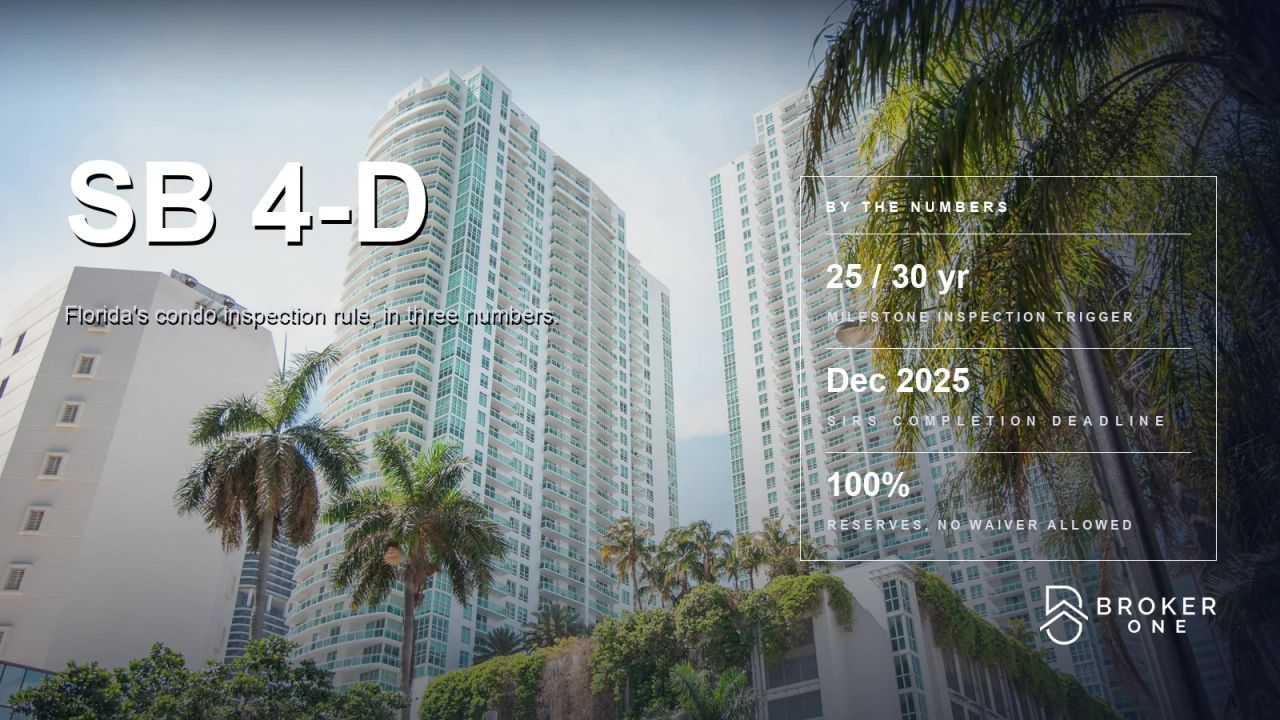
- Milestone Inspection — a Phase 1 structural integrity inspection by a licensed engineer or architect, performed at the 25-year mark (for buildings within 3 miles of the coast) or 30-year mark (all others), and then every 10 years thereafter.
- Structural Integrity Reserve Study (SIRS) — a detailed reserve study identifying the major building systems (roof, structure, fireproofing, plumbing, electrical, waterproofing, windows, HVAC), their remaining useful life, and the reserves required to fund replacement. Required every 10 years.
- Fully Funded Reserves — SIRS-identified items must be funded, not waived. Prior Florida law let associations vote to waive reserves; SB 4-D eliminated that option for structural items effective December 31, 2024.
Key Deadlines You Need to Know
| Requirement | Applies To | Deadline |
|---|
| Phase 1 milestone inspection | Buildings 3+ stories reaching 25 years (coastal) or 30 years | December 31 of the year the building hits the milestone |
| SIRS initial completion | All existing qualifying condominiums and co-ops | December 31, 2025 (missed deadline for many) |
| Reserve funding begins | All SIRS line items | Budget year starting after SIRS delivered (i.e., 2026 budgets for most) |
| Association website requirement | Condos of 25+ units (was 150+) | Effective January 1, 2026 |
| Buyer inspection period | Buyer receipt of association documents | 7 business days to review and cancel contract (effective 2026) |
| Subsequent milestone inspections | Every building after first Phase 1 | Every 10 years |
Critically, the 2026 buyer inspection window is new. Under updated condo disclosure rules effective this year, a buyer has seven business days after receiving the association's governing documents (declaration, bylaws, rules, financials, inspection reports) to cancel the contract with no penalty. Any good buyer's agent should make sure this window starts counting from the day you actually receive the documents — not the contract effective date.
Why This Is Hitting 2026 Closings
The timeline math matters. Buildings that reached the 25-year coastal milestone during 2025 were supposed to complete Phase 1 inspections by December 31, 2025. Many didn't. Those that did often discovered significant deferred maintenance — concrete spalling, roof replacements, stack repairs — that translated into special assessments in the range of $5,000–$150,000 per unit.
In one widely reported Miami case, a 16-year-old building (not yet at its milestone) issued a $21 million special assessment to cover repairs identified during pre-milestone due diligence. That's an entire unit's worth of value on a 40-unit building — paid by current owners, not the buyers who will sell to next.
SB 4-D did not create the underlying structural issues. It forced them into daylight. Buildings with deferred maintenance that were easy to ignore now have a legal deadline attached.
Reading a Building's SB 4-D Status Before You Offer
Before you write an offer on any Florida condo three stories or taller, your due diligence should include:
- Phase 1 milestone inspection report (if the building has reached its milestone). Read the engineer's summary and any "immediate action" items. A clean Phase 1 is a meaningful asset; a Phase 1 flagging multiple items means Phase 2 detailed inspection is coming, with bigger costs behind it.
- SIRS reserve study. Look at the funded percentage of each line item and the remaining useful life. A SIRS showing the roof at 3 years remaining life and 15% funded is a four- or five-figure special assessment waiting to happen.
- Two years of budgets and actual financials. Compare to the SIRS — are reserves actually being funded as the study requires?
- Special assessment history (5 years) — both levied and pending. Look for a pattern: frequent small assessments often indicate a reactive board; none followed by a large one indicates either a very well-run building or one that's been ignoring structural needs.
- Insurance renewals and any insurance carrier notices. Post-SB 4-D, insurance carriers are using the milestone inspection outputs to set premiums — and a handful of carriers have stopped writing older non-compliant buildings entirely.
The association is required to provide these documents on request under Florida statute. If documents are "unavailable" or delayed, that's a signal in itself.
How SB 4-D Interacts With HOA Fees and Reserves
Before SB 4-D, Florida associations could and often did vote to waive or partially fund reserves to keep monthly dues low. That made sense on a spreadsheet — until a component failed and the association had to levy a special assessment to cover replacement. Owners paid the same money either way, just framed differently.
SB 4-D moved the money from the deferred column to the current column. The practical effect on South Florida condos reaching milestone age:
- Monthly dues commonly up 20–40% to meet SIRS-required reserve contributions
- Older buildings (especially pre-1990s beachfront towers) seeing 50–100% increases or one-time special assessments instead
- New-construction buildings with SIRS baked into their financial model since day one — fees 10–20% higher than 2021 equivalents, but with no catch-up shock ahead
Our HOA fee breakdown by area has the current numbers by building tier.
The Buyer's Actual 7-Day Review Checklist
You get seven business days. Use them:
- Day 1: Confirm Phase 1 milestone inspection status. If the building has reached milestone age but not completed Phase 1, understand why.
- Day 2–3: Have a qualified person (attorney, CPA, or engineer) review the SIRS and compare reserve funding percentage to the stated funding plan.
- Day 3–4: Read the 2-year historical budget and actual financials. Are reserves actually being funded per SIRS?
- Day 4–5: Get clarity on any special assessments — both in the last 5 years and pending. Pending is the most important.
- Day 5–6: Confirm current insurance coverage, deductible, and carrier. Windstorm + flood + property coverage on older beachfront buildings is the most volatile piece of the budget.
- Day 6–7: If any findings are material, use the right to cancel — or renegotiate price with a credit for known upcoming assessments.
What Good SB 4-D Compliance Looks Like
Not every Florida condominium is a problem. The buildings that are doing this well share a few characteristics:
- Phase 1 inspection completed on time with no flagged items, or with flagged items already remediated
- SIRS funded at 70%+ for each structural line item, with scheduled increases to reach 100%
- Transparent board meetings and posted financials (now mandatory for 25+ unit associations as of 2026)
- A reserve fund equivalent to 15–25% of annual operating budget beyond SIRS items
- Insurance renewed annually with a stable primary carrier — not in the Citizens (state-backed insurer of last resort) pool
When you find a building like this, the higher monthly dues are a feature, not a bug. You are buying certainty about your carrying cost rather than waiting to be surprised.
Questions Every Florida Condo Buyer Is Asking
- Is it smart to buy a Florida condo right now?
- For the right building — yes. For the wrong building — the holding cost can exceed the mortgage. The SB 4-D disclosures are how you tell them apart. We cover the big picture in our reserve fund requirements guide and the specifics in special assessments.
- How much does a milestone inspection cost?
- $6,000–$25,000+ for Phase 1 on a mid-size building, depending on height and complexity. The cost is borne by the association (i.e., ultimately by unit owners), not the buyer at closing. What the buyer is pricing in is the risk the inspection surfaces.
- Can I still buy a building that hasn't completed its milestone inspection?
- Yes, but you're taking on the risk of the unknown. The building may be entirely fine — or it may have a five-figure assessment inbound. If the seller refuses to provide a Phase 1 status, treat that as the answer.
- What about new-construction condos — do they need SIRS?
- New construction doesn't need a milestone inspection (it hasn't reached 25/30 years), but SIRS is required within the first year of conveyance of a unit to a non-developer owner. New buildings are the cleanest play for avoiding the catch-up pain.
- Do these rules apply to co-ops?
- Yes. Chapter 719 co-ops are subject to parallel requirements under the same legislative package.
The Bottom Line
SB 4-D is not an obstacle to buying a Florida condo. It's a disclosure regime that rewards buyers who do their homework and penalizes those who don't. The best condos in Miami-Dade, Broward, and Palm Beach come out of SB 4-D compliance stronger: transparent financials, funded reserves, documented structural health, and fewer surprises. The worst come out with five- and six-figure assessments spread across owners who didn't see them coming.
Read the docs. Use the seven-day window. Price the risk into your offer. And when a building's financials look healthy post-SIRS, pay the premium for that certainty — it's worth real money.
Before you commit, run your target purchase price through our Florida property tax calculator to get the full picture of annual holding cost, including homestead exemption savings.